I am a dance artist working across screendance and site-specific performance. I am interested in the way dance on film brings attention to the body in time.Over the past decade, my work has focused on time within screendance as a form of stasis or suspension: as something that is simultaneously moving and still (Macdonald 2019). I have suggested that this combination of movement and stillness in the hybrid form of screendance has a particular capacity to evoke a sense of mortality and temporal precarity (Macdonald 2019, 2024).
In this short piece, I reflect on how my interest in screendance, mortality and time was furthered within the making of a new piece called ‘Nearly all the films I’ve made in alphabetical order’ (Macdonald 2024).[1]Through focusing on this work, Iexplore what can happen when screendance exceeds its habitual form, extends out into the gallery and folds into a book. The discussion prompts questions about the material form of screendance and its relationship to analogue sensibilities.
Screendanceand single screens
McPherson writes that, ‘[s]creendance is an umbrella term which has come to include single-screen, installation, online and interactive works’. (McPherson 2023:11) In general though, the term refers to single screen works that are encountered within festival settings, one at a time. This has consequences because, as Sykes writes
‘although screendance content is often experimental, edgy, artful and visually unusual, the form of the outcome is primarily short single screen pieces. This form inevitably restricts the way content is conceived and cut. […] Makers, more often than not, follow established arcs of conceptualising, building and completing that are cohesive with that single screen format, destined for short film festivals.’ (Sykes 223:15)
In the quote above, Sykes proposes that screendance’s formal habits – that of digital video on single screen – restricts it, particularly in terms of its methodological and conceptual relationship to time. This has certainly been true in my work. Most of my films have been made within a singular block of time rather than something that might be returned to each year, for example. I’ve only made two films that are over the requisite 15-minute short film format and I rarely consider what kind of screen I am making for and how the where the work will be watched, assuming a festival style projection screen perhaps.
Although I use the term ‘artist’, my unquestioning acceptance of the form of the work that I work with and for, might seems at odds with what Sykes describes as the ‘challenging, reflexing, flipping, destroying and reimagining’ urge that drivesexperimentation in visual art (Sykes 2023:15).The wider question of why screendance seems reluctant to leave the projection screen is both intriguing and beyond the scope of this writing.[2] Instead, I look at one example of and what happened when it did.
Consolations
My work is more often seen in the single screen format of screendance festivals but is sometimes shown in galleries. Mostly, these have been group exhibitions with other screendance and moving image artists – but in March 2024 I had the opportunity to make a solo screendance exhibition, at Pink Gallery, Manchester. It formed part of a collaborative residency,funded by Arts council England,called New Arrangements (2024) working with artist filmmaker Jenny Baines and curator Katy Morrison.
Baines and I both work with the body, space and screen and focus on solo actions recorded in single shots. Baine’s work sits within the field of Artists’ film and explores the materiality of 16mm film. My work sits within (or at the edges of) screendance and although I use the term film when I describe my work, a point I return to further on, the material I use is digital video. The aim of the project was to explore the intersections and overlaps between moving body on screen operating within our disciplines of dance, fine art and curation through collaborative and solo exhibitions.
As is the case with many screendance artists, research into formal innovation often begin with the adaptation of existing works for different spaces.The development of my work,from single screen to gallery, went in two directions: out and in. I expanded out with scale, working with huge projections spanning the gallery walls. What you see in Fig 2is a projection of moving hands that became as large as a whole person.Rosenberg writes that in screendance ‘our understanding of the body can be decoupled from its corporeal absolutes; the body is reimagined within and by the screen’ (Rosenberg 2012: 53).When I projected giant figures moving across the gallery walls, I realised that scale itself also functions as a kind of screen-based corporeal absolute. My sense of what a filmed body is, comes from the familiar scales at which I usually encounter it – from laptop to festival screen – and these viewing formats quietly shape my screendance practice.
What I focus on in this writing, is anotherpiece made forthe exhibition that gathersthe work in rather than spreadingit out.
In Fig 2, just through the doorwayframed by giant hands, you can see a woman who looks like she is sitting and reading. What she is actually doing is watching a miniature version of one of my films projected onto a page of a book.
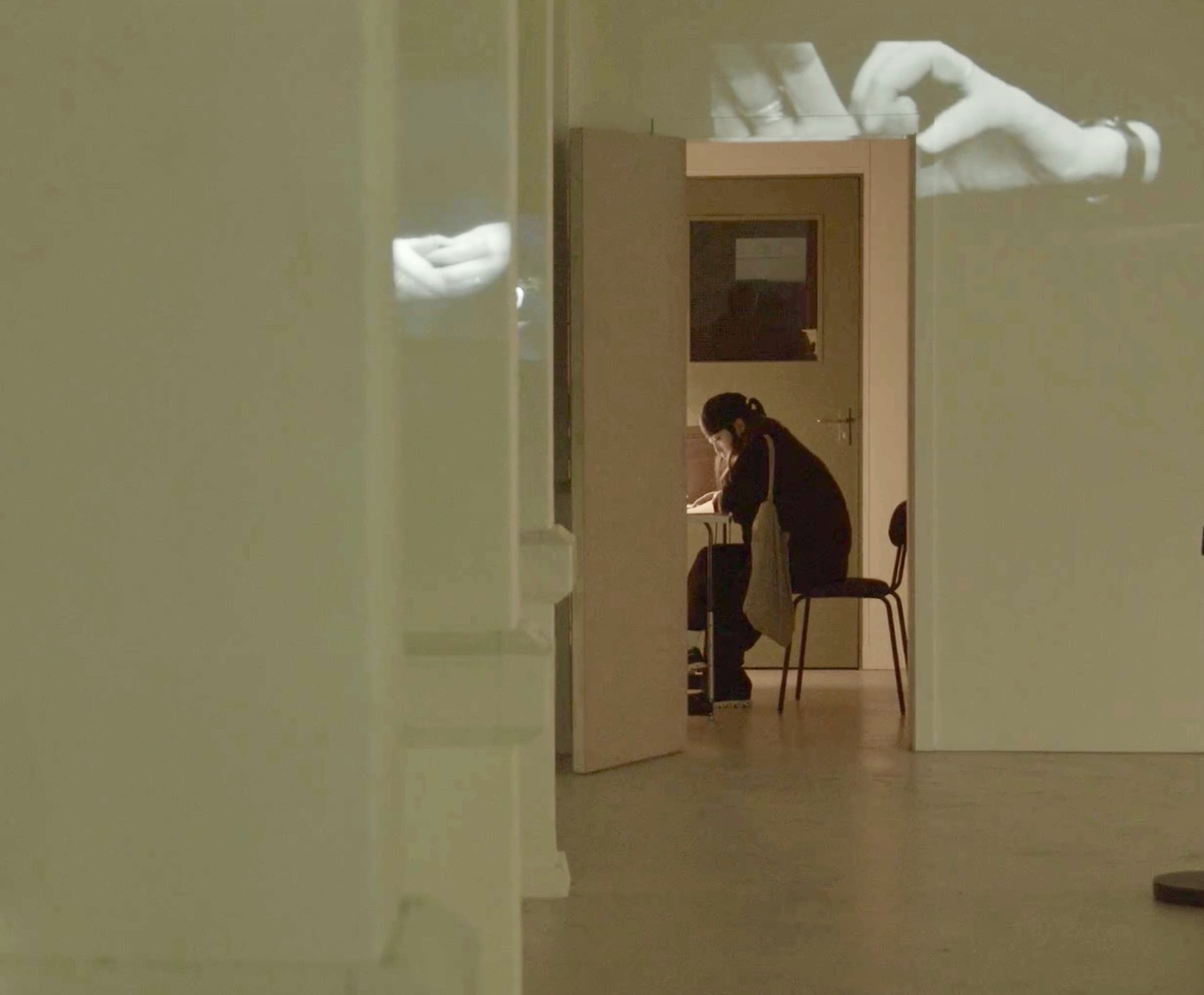
Film still of viewer watching the book of films
My solo exhibition was called Consolations, partly because my work is about loss and partly to consolidate, to bring my work together.[3]Fine art has a history of retrospectives – events that look back over a body of work. In screendance, this is less common as works tend to circulate individually and festivals often focus on recently made works. Perhaps another part was to console myself that I had a body of work to look back on. A way of seeing ‘where am I now?’.
Nearly all the film’s I’ve ever made in alphabetical order
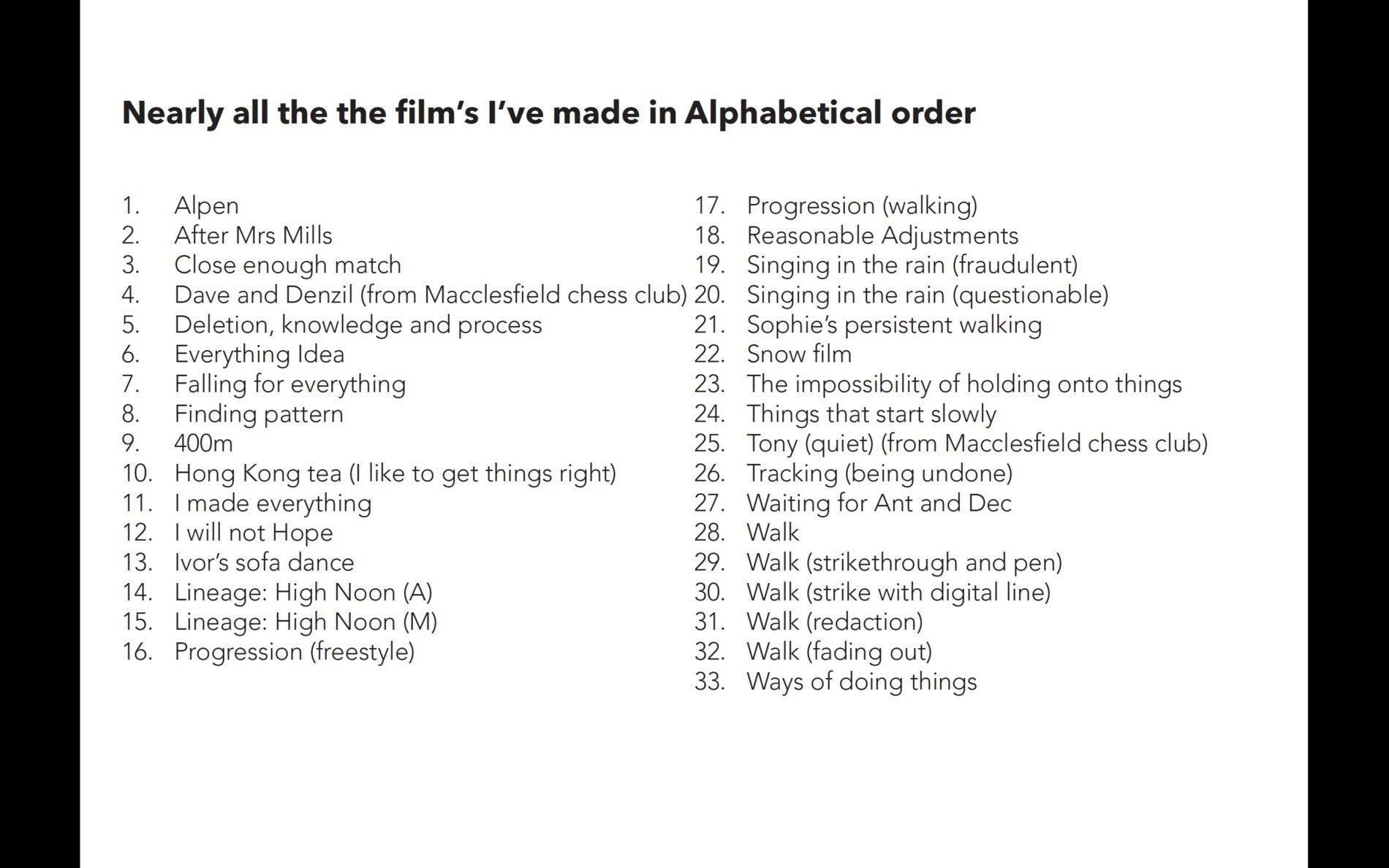
The acts of holding, looking back and replaying are very much part of my practice and I began the process of developing my solo exhibition by writing down the titles of all the films I’ve made – or could remember making (See Fig 3). I make short films. Films that can be made with small budgets in between childcare and teaching. There were33 of them at the time of making. Then there was the question of what to share and how to group them? In her (2023, 2025) researchinto the development and form of screendance festivals, Cara Hagen note show screendance programming has developed rapidly in recent years, shifting from a process of programming from works submitted to open calls, to a morecuratorial practice that helps scaffold and refine the field (Hagen, 2025:1). However, it is still common to find works selected by theme rather than material or dynamic qualityin many festivals. Could I group my films by dominant colour orthe weather at time of filming? How many films could I fit in the space and how much would people watch?
Rather than a single projection unfolding autonomously in a festival, exhibitions invite movement, return and re-ordering. A useful question then was which of my works didn’t need to be seen start to end?The answer to this was very few and so I looked for a way of sharing everything I’d made. My first idea was to create a film which contained one minute of nearly all of the films at once, see Fig 4.[4]This was interesting,and I would recommend it for artists as a way of reflecting on their practice, but it made me realise that what I actually wanted was a way of sharing all the films, having them all available, but not all at once.
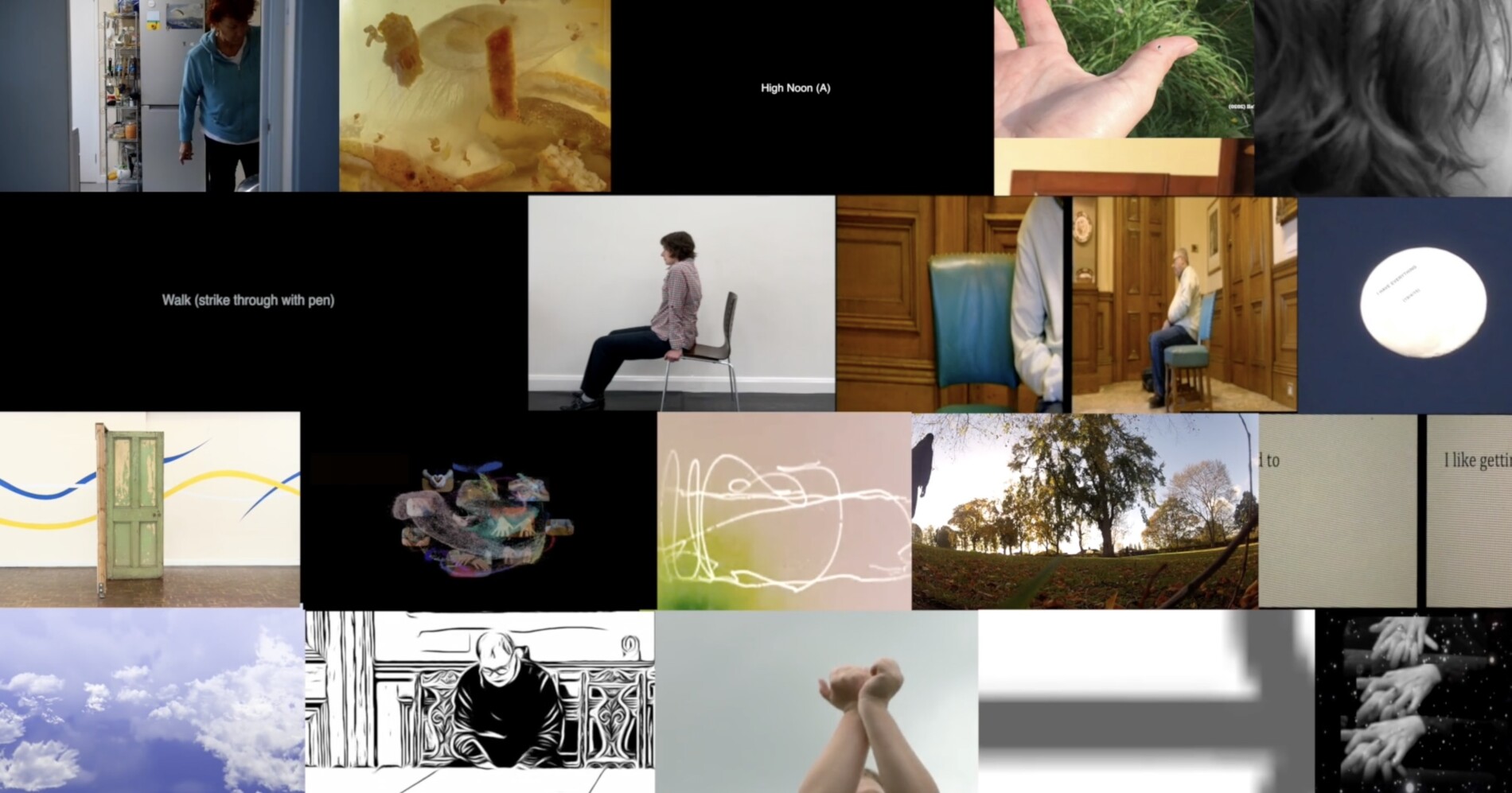
Film still from one minute of most of the films I’ve made
It was when I was thinking about the act of browsing that I came up with the idea of a book that would contain all my films. I wanted it to be like magic, as if the films were actually inside the book. I liked the idea that visitors (noting that I was already thinking about visitors rather than viewers)could turn the page to watch one film, flick through, or turn to the last film on the last page. All the films would be there, and this part of the exhibition could be self-curated by the viewer.
Working with my long-term collaborator Dominic Smith, we created a book that starts with a page that lists all the works I’ve made in alphabetical order (See Fig 3 above). There is a page number by each entry and when you go to the page there is some information about that film. The page number for each film also doubles as a digital marker. In the installation,a camera is placed inside a small lamp over the table which reads the marker and tells the small computer that has no screen (taped under the desk) to play the corresponding video. This computer is linked to the projector, which is concealed in a very large lamp focused over the page. When the marker is read the film starts to play.
Smith is a digital artist who looks for the simplest way of doing things. I work with Smith as often as I can because his analogue approach to digital materials, resonates with my own. We worked remotely. He tested things at home, told me what kit to order and sent me the code to enter.[5]The set up was what my mother would have called a Heath Robinson affair, whichrefers to a ramshackle and whimsical approach to making where complicated systems are used to do relatively simple things.[6] Here though, we were trying to do something quite complex in the simplest most low-tech way we could. The full title of the piece (in true post structuralist pragmatic form) is nearly all the film’s I’ve made in alphabetical order, but it gets referred to in shorthand in this writing as the book of films.
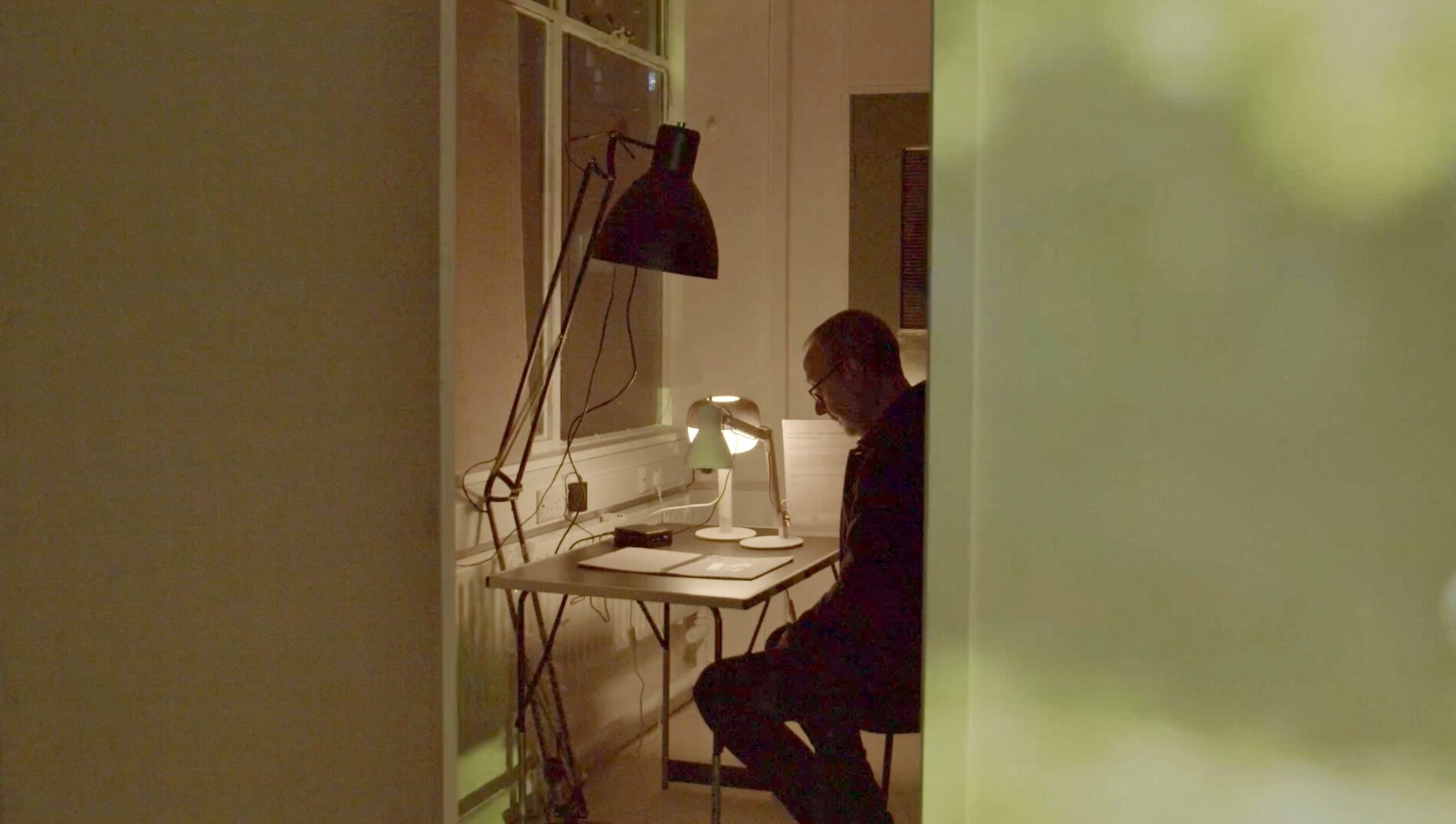
Film still of viewer watching the book of films
The film sits on the paper and the viewer/reader is invited to watch a film as if they are reading a book. The work offers a familiar yet strange combination of movement and stillness. Although as Seago and Sykes note both dance and film are “intrinsically dynamic.” (Seago and Sykes 2019, p.3), books are still. Our eyes move as we read but the words stay on the page so when the image starts to move in this artwork, it’s a bit like something magic appearing.
There is clearly a desire to animate analogue sensation around digital video, in this work. For as you watch the film on the page, your eye is drawn to the materials: to the process of something materialising. To watch each film the viewer must touch the materials of the page inviting a tactile, embodied moment of spectatorship. There is also an analogue feel of causality (this leads to that) as you turn the page and a film appears. As soon as the page is turned, and the camera no longer reads the marker, the film stops playing.
Kappenberg notes thepropensity forscreendance makers to evoke analogue qualities in their digital works, giving the example of the use of digitally produced glitches (Kappenberg 2024:366). She describes this as an act of compensation which aims to bring close connections between digital images and the body through emulating analogue materials (ibid).In one way this project is an example of this compensatory drive, for the videos in the book are small and flickery, resembling projected film. They also appear grainy because of their low resolution and the textured paper they are projected on. But this aesthetic is not simulated because the flicker derives from a small computer struggling to stream the films, or the projector shaking due to footsteps on the gallery floor.[7]In this way, the book of films works to reinscribes what Kappenberg describes as ‘the precariousness of physical existence that are often filtered out of the modern mediated environment’ (Kappenberg 2024:365).
Small, situated and singular
I can’t remember now why the films are listed in alphabetical rather than chronological order. Why not arrange them according to when they were made? What does alphabetical ordering do here? On reflection, there is a sense of timelessness created by this ordering because it avoids a narrative progression of early, mid-career or recentlymade films.Listing the works alphabetically is a form of retrospective consolidation, but the effect is more archival than retrospective. Rather than presenting the films as part of a linear progression, the ordering produces a sense of archival simultaneity.[8] This feels appropriate because I am not aware of consciously trying to refine or develop a practice over time in the way some artists describe.[9]
Although the way the films are listed might produce a sense of contemporaneity, the book, the form that holds them, is something we experience durationally. As McDowall writes,
‘[b]ooks are experienced in time, and they are an experience of time – there is the moment of reading and there is the constitutive temporal aspect of the work.’ (McDowall 2018: 21).
Unlike film screenings, however, books (like gallery exhibitions) permit skipping, returning and dwelling.I had imagined that people might dance through the archives a little and skip through the films but during the exhibitionI was surprised to see that many people chose to watch individual films in their entirety. They didn’t watch the films sequentially, in alphabetical order, they might skip forward five pages, but in general people chose not to fragment individual works and watched with a quality of concentration and care that I found very moving. In this final section,I consider how the scale and context of the work might contribute to thatcareful viewing.
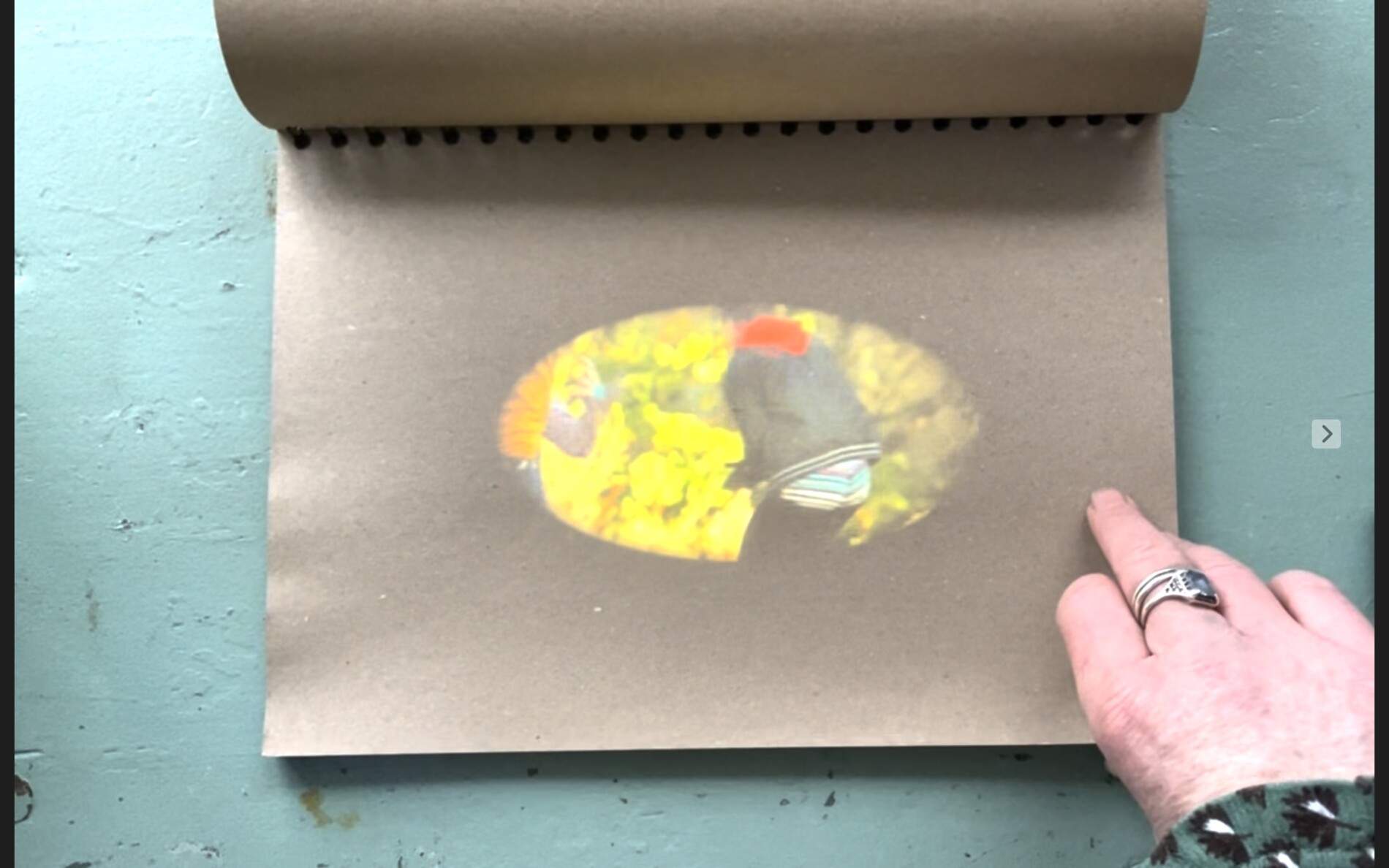
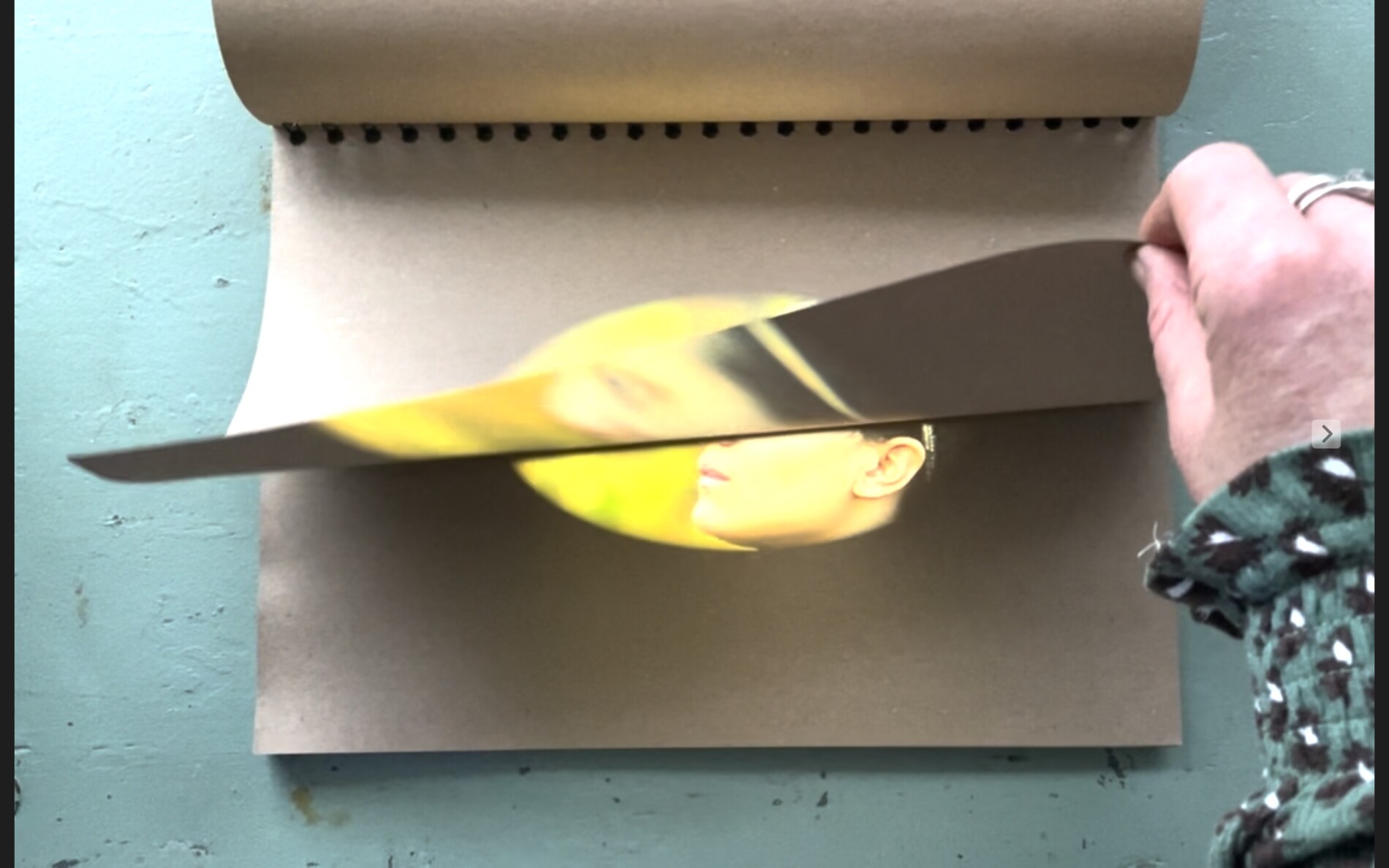
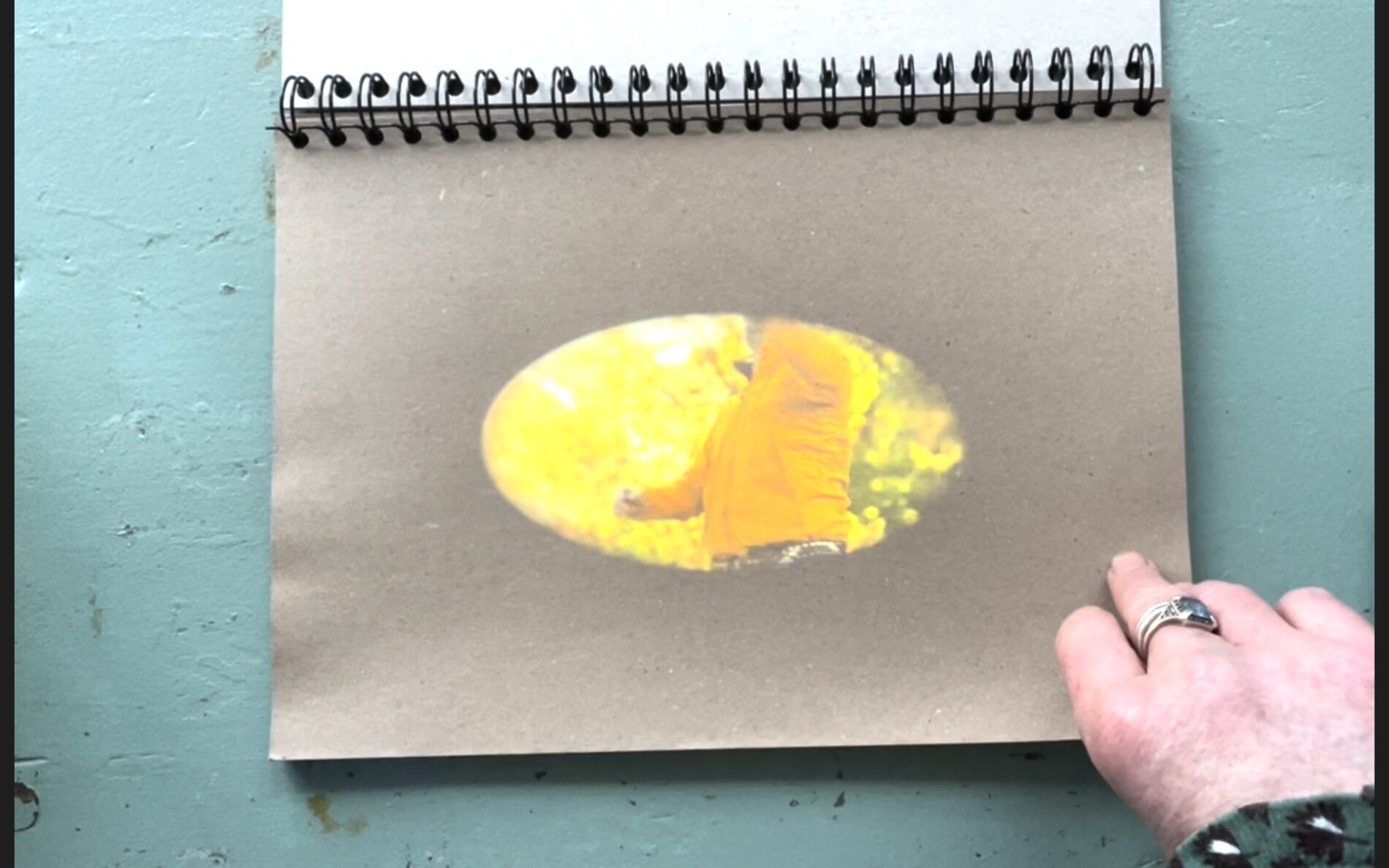
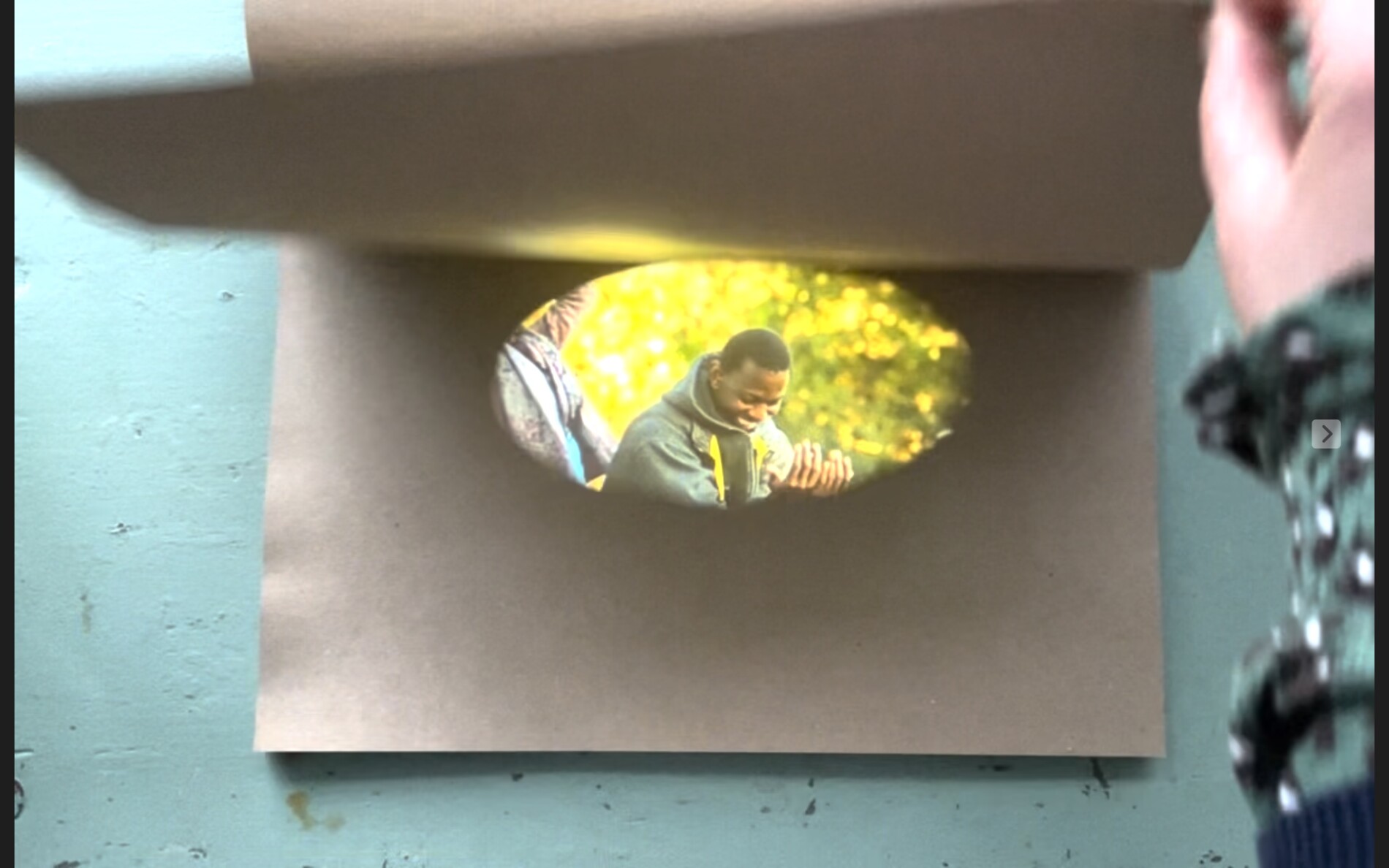
Film stills of viewer watching the book of films
The image on the page is very small, perhaps 5 by 8 cm. It is a stand in for the film (at full size)but it is also the film itself because the full duration of the film is available to see. We are used to looking at films on phones of course but this image is miniature rather than something scaled. This means that the detail of the image is harder to discern, and my sense was that this asks the viewer to look carefully.
Unlike other small films watched on our phones, it is clear in this work that the film is not portable. Like a conversation on an old-fashioned landline, that is a situated event, which potentially encourages a sense of commitment.[10]You needed to choose to go into the room to see the films. Unlike the film festival screening where film after film comes to you, here you need to go somewhere and do something for the film to appear.
People watched the films with a sense of gravity– as if viewing a book of remembrance. Perhaps, this was because unlike a film festival where we watch with others, this work provides a near private viewing experience where you can take as much time as you need to watch the films.There is only one chair, and this is placed at the back of the gallery in a small separate room. The room resembles a special section of a library, an archive perhaps, whichinvites a quiet quality of concentration. In the pictures you can see that the reader is visible to those in the main gallery. An awareness of being watched, I imagine mightalso intensify the experience of watching.
A willed and fragile act
The films are all contained within the book: held and held up for people to see. In this sense they are safe, but also static. Screendance is already a kind of archive: self-indexing and self-contained, a trace of past liveness waiting to be activated again by a viewer. Placing all the films within this glitching, precarious and slightly magical book draws attention, perhaps, to the effort involved in that activation. It foregrounds the labour of re-animation in screendance- the effort required to bring something back into movement.
As Auslander argues, when we agree to the demands of a digital record and encounter it as live, we become complicit in sustaining its sense of immediacy. He describes our ability to ‘hold on’ to this participatory liveness as ‘a willed and fragile act’ that requires ongoing attention (Auslander in Macdonald 2024: 141). In the book of films, the films are animated and then returned to stillness as the page turns. The work draws attention to this oscillation between movement and stasis, and to the ‘tenuous nature of affective connection’ that I have argued elsewhere is part of the ontology of screendance(Macdonald 2024: 141).
I refer to my works as films, even though they are technically digital videos, because of their affinities with analogue practices. What I enjoy about the book of films is the way it accentuates this quality. While the relationship between screendance and lo-fi aesthetics has received insightful scholarly attention in recent years (Guy&Thain 2024), my interest here was in exploring conditions for showing the work that might amplify or sharpen the affective intentions of the films. Thinking through these material conditions now helps me re-consider how future work might be made.
For now, though, I like the modesty of the object. The book looks as though it could be left in a corridor or a side room. It is small, and it contains everything I have made so far. There is something satisfying in laying the works out like this – simply presenting them together and saying: this is the body of work, at least for now, in alphabetical order.
References
Auslander, P. (2012) ‘Digital Liveness: A Historic-Philosophical Perspective.’ PAJ: A Journal of Performance and Art, 34:3 pp. 3-11.
Guy, P., &Thain, A. (Eds.). (2024). LO: TECH: POP: CULT: Screendance Remixed. London: Routledge. https://doi.org/10.4324/9781003335887
Hagan, C. (2022). Screendance from Film to Festival: Celebration and Curatorial Practice. Jefferson, North Carolina: McFarland & Company.
Hagan, C., (2025) “IJSD Volume 15 2025 Special Issue: FESTIVALS (Full Issue)”, The International Journal of Screendance 15(1). doi: https://doi.org/10.18061/screendance.6295
Kappenberg, C. (2024) The Matter of Analogue Media Technologies in Screendance, Post Martin Heidegger and Post Hito Steyerl.In LO:TECH:POP:CULT: Screendance Remixe. London: Routledge.DOI: 10.4324/9781003335887-22.
Macdonald, A. (2017) Going Nowhere: Screendance and the time of dying. International Journal Screendance, 8.
Macdonald, A. (2019) Acts of Holding: Dance, Time and Loss. PhD thesis. Manchester Metropolitan University.
Macdonald, A. (2024) Keeping in time: Mastery, as a condition of colonial and patriarchal discourse, and the temporality of screendance. In LO:TECH:POP:CULT: Screendance Remixe. London: Routledge.
McDowall, J. C. (2018) The time of reading: artists’ books and self-reflexive practices in literature. PhD thesis, University of Leeds.
McPherson, K. (2023) A Space of Time: The Evolution of a Screendance Practice. PhD thesis, Edinburgh Napier University. https://doi.org/10.17869/enu.2023.3175350
Nearly all the films I’ve made in alphabetical order. 2024. Media Installation. Lead Artist Anna Macdonald&Digital artist Dominic J Smith.
Rosenberg, D. (2012) Screendance: Inscribing the ephemeral image.Oxford: Oxford University Press.
Seago, C. & Sykes, L. (2019) Rediscovering Time Perspectives. Body, Space & Technology Journal, [online] 18 (1), p. 297–320. DOI: https://doi.org/10.16995/ bst.321.
Sykes, L (2023) The Art of Screendance: revealing a location led methodology. PhD
Anna Macdonald is a dance artist/scholar whose work moves between moving image and performancepractice. Her work focuses on the relationship between the body, time and affect and uses film to expose the resonance of simple movements, such as, moving from ‘here to there’, ‘holding’ or ‘getting slower’. Her work is regularly exhibited internationally in both festival and gallery settings and has generated interdisciplinary findings in the fields of health, science and law, within large-scale projects funded by AHRC, Arts Council England and Wellcome Trust. She is a Reader in Movement based at UAL: Central Saint Martins,and a Senior associate research fellow at the Institute of Advanced Legal Studies, London.
Dominic Smith is an artist and curator whose practice involves project development through a hands-on, open approach to working with art & technology. He has a Doctorate from Sunderland University that examines the relationship between open source software production methods and collaborative methods employed by artists and curators.His curatorial practice focuses upon the use of new technologies and audience engagement through experimental participatory methods.He currently works as associate digital curator with a number of organisations and Galleries including D6 – Culture in Transit, and Queens Hall Arts, developing innovative digital arts programmes.
[1] You can see a short film of this piece here https://vimeo.com/929146515
[2]As Hagen writes, ‘while screendance festivals are not the only places where dance films may be screened, they have historically acted as sites where the form is defined and reified such that over time.’ (Hagen 2025:1). There are also many great examples of screendance festivals working in gallery spaces, but this does not always involve a challenge to the single screen format, shown on loops in discrete projections.
[3]In my work(Macdonald 2017, 2019) I have made parallels between the temporality of screendance and dying focusing on the idea of movement that doesn’t go anywhere.
[4]https://vimeo.com/909012019
[5] The code we used was A-Frame. A-Frame is a web framework for building virtual reality experiences.
[6]Named after the English cartoonist and illustrator W. Heath Robinson (1872–1944).
[7]In fact, the whole set up was precarious as the lamp/projector was easily knocked resulting in the image slipping at an angle to the side of the page and sometimes the whole system became overwhelmed I had to re-set it.
[8]This list-like quality is accentuated by the fact that you have to turn the pages of the book upwards rather than right to left like a story book.
[9]This non-progressive arrangement resonates with the works themselves, which are often concerned with event-based time: the duration of the film being determined by the time required for an action to be completed (Macdonald 2019), rather than by a sense of development.
[10]Although a lot of screendance uses site as a distinctive part of the work, the films themselves are often expected to have the same effect when screened in different contexts. Moving any screendance into a gallery, however, immediately invites an awareness of the impact of site on viewing.