“The wing beat of history” is a kind of umbrella concept for the reminiscences and memories we encounter in everyday life – whether slivers of love or of war: all our experience seems gathered in an inner archive we cannot fully control. Memory is therefore not merely unreliable but also ungovernable; anarchic force within the body that, in periods of grief and loss, can be anything but beautiful. To remember can be to fall, or to rise. If one is fortunate, it may be to drift quietly through the layhers of time that is our home. If unfortunate, one is hunted intensely by anxiety – like an animal fleeing its own shadow.
The word vingslag (Swedish) – wing beat in English – translated into visual form grants memory the freedom to move, rise and fall like a bird crossing the sky, the out stretched wings becoming a canvas for the memory-image, while the movement the wing embodies can swiftly become a strike. Who has not stood close to a bird that suddenly took flight too near, or swooped close, and felt a sting offear: Am I in danger?
A difficult memory seldom arrives with a feather-light touch. It is more like an assault and for a moment – or a long while – we are enclosed in our pain, until the bird of memory lifts and frees us from the experience of being prisoners of the past.
In the aftermath of Vingslag‘s intensity I find it impossible not to be carried out of the performance space, away from dancer Fanny Kivimäki’s precise movements and the austere scenography, and into the existential depths the piece opens. This even as my erratic notes reflect that during barely an hour I also experienced something entirely concrete: movement, body, stage, light. The scenography is so spare that its three elements are fully saturated with meaning: a bed. A table. A net between us and the dancer.
Let’s begin there: the net. Black, relativly loose stichtes. From ceiling to floor. We are at once excluded and invited – the net effectivly separates the audience from the stage. We cannot reach in, but we see everything. The effect on the audience is implicitly that we experience also the helplessness of our own bodies—trapped!
However, Kivimäki’sintensity gradually dissolves the sensation of distance, yet the net remains throughout. We never come truly close to another person. How close do we even come to ourselves?
These are some of the questions that Kivimäki’s alternately tentative and forceful attempts to negotiate the room’s invisible forces bring to the stage.
Let’s return to the room. A simple table. A bed. These are two attributes we associate with survival. One must sleep. One must eat. Such are the body’s most basic needs. The possibility of survival is thus laid before us. But what if one cannot sleep in the bed? Or eat at the table?
And a bed is also associated with encounters of love, with loving –yet another fundamental need.
The perspective at the opening of the piece is from below. Kivimäki lies beneath the bed. It is dark. Below: what does that mean? To be held down? To hide? We cannot see the dancer until a hand slowly explores their options of visibilty and movement: do I dare? Hand. Then feet.
There is an openness in Vingslag, an avoid anything didactic or pedagogical, and like wise an avoidance of ”The Correct Interpretation”. This is not a ”story” unfolding but sequences of movement that prove open to entirely different emotional responses. The audience in Kiruna[1], Esperi tells us at the outset, saw the town’s relocation and the significance of the mine in the piece. I, on the other hand, see a violent reckoning with the past; a relationship, since the bed is central. A bed whose memories exert a powerful pull, that only sometimes manages to lift, to evaporate. It certainly refuses the idea that letting go is an ”art” – it is a struggle.
By the time hand and foot have dared to move out from the cramped space beneath this bed, and eventually the dancer’s whole body appears, my conviction about the present pain is already set hard in me. This hurts.
Good.
Franz Kafka held that a good book should be like ”an axe that breaks the frozen sea within us”. The same is true, I would argue, of every work of art. And when the performance ends I do not want to stay with the others and raise a glass: I want to go home. My eyes ache – I am shaken. Kivimäki’s struggle in the cage that beneath the table becomes on stage, is hard to shake off. What is it that truly hold sus captive?
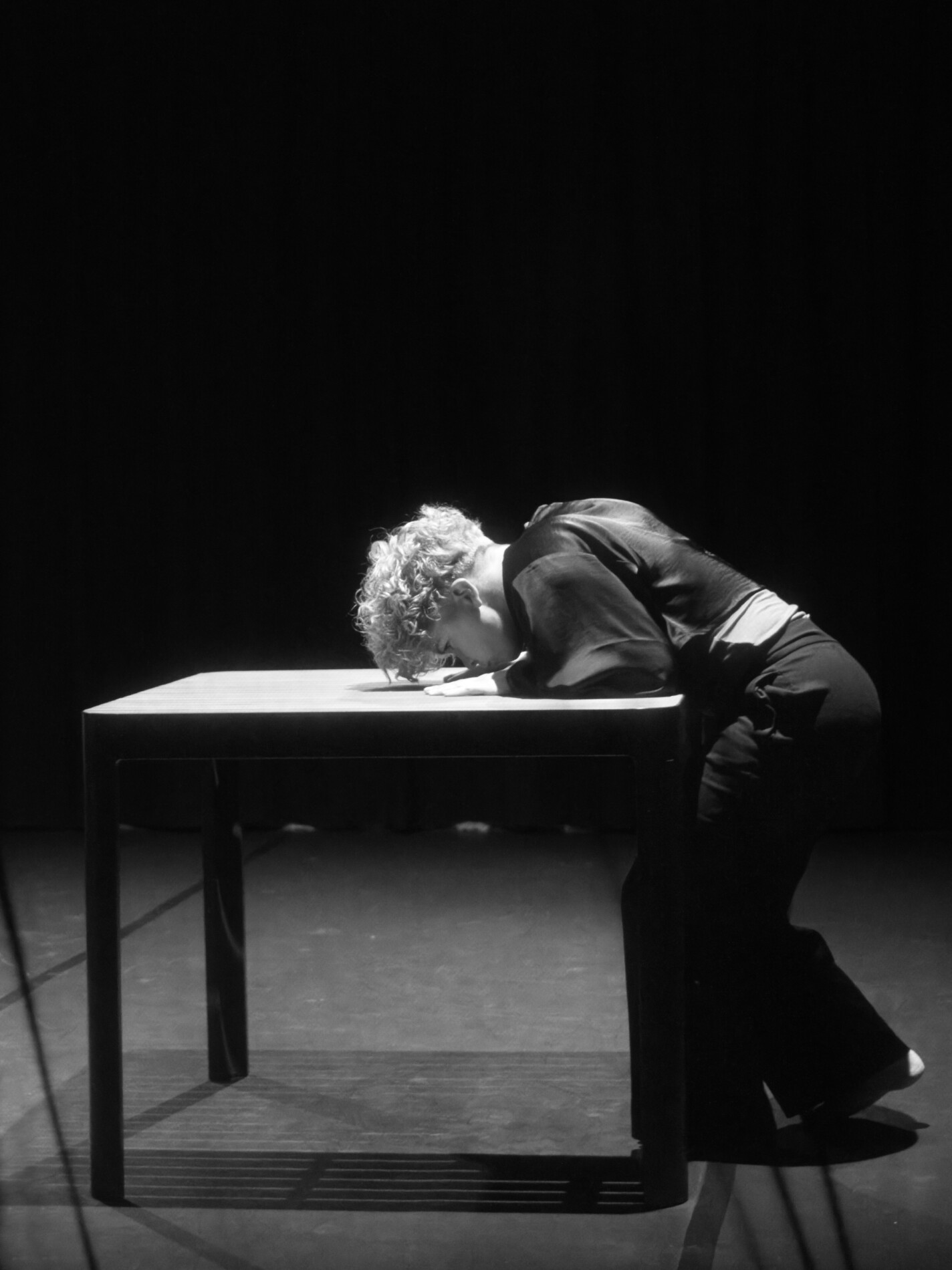
Ph: Per Bornstein
With more and more intensity Kivimäki breaks free; throws herself, rolls, dares to claim space in the room and liberate herself from bed and table. Here is a dancer of powerful physical integrity, as precise as she is violent in her fight to reclaim something that is at times so beautiful it must be caressed with bare hands, and later so destructive it must be cast aside. The final scene gathers every thread, and, in its rapid tempo, is razor-sharp. The lighting suddenly shifts and onto the black net is projected a door, a window, the outlines of a room: a lamp takes shape only to be erased just as quickly, line by line, piece by piece – and then the room is gone.
I read this final scene along side the opening quotations (projected on the net in the beginning) from Rebecca Solnit – who argues that getting lost is necessary for living autentically, that if we never lose our way we have not lived. Solnit concludes with ease that we must dare to find what we do not know weare seeking– and it is in the spaces in between finding the right way and getting los our lives very often arise. I fully agree with her and I have cherished Solnit’s long essay A Field Guide to Getting Lost for many years – yet walking home, along the pavement and under the viaduct, I arrive at a different perspective on her light steps across the unknown. Yes, one should get lost in life – but not in one’s own house. Yes, one should be open to the possibility that in the cracks between happiness and despair there is something precious, if one is lucky even life changing and forever shaping – but I no longer believe the injunction to get lost is uncomplicated.
Those who have truly been lost once will know something that runs far deeper than any wish to ”find the light in the darkness” or believe that “everything happens for a reason”. Such a person will due to her or his pain conclude that one ought to obtain an adequate map. The aftermath of Vingslag tells me ”one needs to be careful”– this as Kivimäki’s combative body has depicted precisely how difficult it is to survive one’s life if one has once had to struggle to climb out from under the bed, from under the table. And at the same time know that parts of that table, that bed, once were what made one want to live.
**
Vingslag (2026) will be performed again 25 th and 26 th of November at Finnekumla Dans-och Konstscen and in Kiruna in the spring of 2027.
Concept, choreography & video: Benedikte Esperi; Dance: Fanny Kivimäki; Music: Cha Blasco; Animation: Jule Goerke; Lighting & scenic design: 3:e Våningen’s Stiltje Asplund; The performance is a stand alone continuation of Det bor inga duvor här längre (2022). Translated from Swedish. Originally written in response to the premiere of Vingslag at 3:e Våningen, Gothenburg, 2026 and an earlier and slightly different version published in Danstidningen.
Photos: Per Bornstein.
[1]Kiruna, a Swedish town far upnorth is where Vingslag was produced and rehearsed. Kiruna is a town center earound a mine and now, because of the development of old mine, large parts of the entire town needs to be moved. It is a very unusual and big project and alters the town entirely. Every night there is construction work.
*”Batir de alas” en sueco.
«El aleteo de la historia» es un concepto que engloba las reminiscencias y los recuerdos que encontramos en la vida cotidiana, ya sean fragmentos de amor o de guerra: toda nuestra experiencia parece acumularse en un archivo interno que no podemos controlar por completo. La memoria, por lo tanto, no solo es poco fiable, sino también ingobernable; una fuerza anárquica dentro del cuerpo que, en momentos de duelo y pérdida, puede ser cualquier cosa menos hermosa. Recordar puede ser caer o levantarse. Si uno tiene suerte, puede ser flotar silenciosamente a través de las capas del tiempo que conforman nuestro hogar, si no, es perseguido intensamente por la ansiedad, como un animal que huye de su propia sombra.
La palabra sueca vingslag, en español, significa batir las alas. Traducida a una forma visual, otorga a la memoria la libertad de moverse, ascender y descender como un pájaro que cruza el cielo; las alas extendidas se convierten en un lienzo para la imagen de la memoria, mientras que el movimiento que encarna el ala puede convertirse rápidamente en un ataque. ¿Quién no ha estado cerca de un pájaro que de repente alzó el vuelo demasiado cerca, o que se abalanzó sobre él, y debido a ello sintió un punzamiento? ¿Estoy en peligro?
Un recuerdo doloroso rara vez llega con delicadeza. Es más bien como un asalto, y por un instante —o un largo rato— nos vemos atrapados en nuestro dolor, hasta que el ave de la memoria se alza y nos libera de la experiencia de ser prisioneros del pasado.
Tras la intensidad de Vingslag, me resulta imposible no sentirme transportado fuera del espacio escénico, lejos de los movimientos precisos de la bailarina Fanny Kivimäki y la austera escenografía, hacia las profundidades existenciales que la obra abre. Esto, incluso cuando mis notas erráticas reflejan que, durante apenas una hora, también experimenté algo completamente concreto: movimiento, cuerpo, escenario, luz. La escenografía es tan minimalista que sus tres elementos están completamente cargados de significado: una cama, una mesa, una red entre nosotros y la bailarina.
Empecemos por ahí: la red. Negra, con puntadas relativamente sueltas. Del techo al suelo. Nos sentimos a la vez excluidos e invitados: la red separa efectivamente al público del escenario. No podemos alcanzarlo, pero lo vemos todo. El efecto en el público consiste, implícitamente, en que experimentamos también la impotencia de nuestros propios cuerpos: ¡atrapados!
Sin embargo, la intensidad de Kivimäki disuelve gradualmente la sensación de distancia, aunque la esencia permanece. Nunca llegamos a estar verdaderamente cerca de otra persona. ¿Hasta qué punto llegamos a estar cerca de nosotros mismos?
Estas son algunas de las preguntas que los intentos, a veces tentativos y a veces enérgicos, de Kivimäki por negociar con las fuerzas invisibles de la sala, plantean en escena.
Volvamos a la habitación. Una mesa sencilla. Una cama. Estos son dos elementos que asociamos con la supervivencia. Hay que dormir. Hay que comer. Estas son las necesidades más básicas del cuerpo. La posibilidad de sobrevivir se nos presenta así. Pero ¿qué ocurre si uno no puede dormir en la cama? ¿O comer en la mesa?
Y la cama también se asocia con los encuentros amorosos, con el acto de amar, otra necesidad fundamental.
La perspectiva al inicio de la pieza es desde abajo. Kivimäki yace debajo de la cama. Está oscuro. Abajo: ¿qué significa eso? ¿Estar inmovilizado? ¿Esconderse? No podemos ver al bailarín hasta que una mano explora lentamente sus opciones de visibilidad y movimiento: ¿me atrevo? Mano. Luego, pies.
En Vingslag hay una apertura, un evitar cualquier objetivo didáctico o pedagógico, así también, escapa de «La interpretación correcta». No se trata de una «historia» que se desarrolla, sino de secuencias de movimiento que se abren a respuestas emocionales completamente diferentes. El público de Kiruna [1], Esperitellsus desde el principio, vio el traslado del pueblo y la importancia de la mina en la obra. Yo, en cambio, veo un ajuste de cuentas violento con el pasado; una relación, ya que la cama es central. Una cama cuyos recuerdos ejercen una poderosa atracción, que solo a veces logra elevarse, evaporarse. Ciertamente rechaza la idea de que soltar sea un «arte»; es una lucha.
Para cuando manos y pies se han atrevido a salir del estrecho espacio bajo esta cama, y cuando, finalmente, aparece el cuerpo entero de la bailarina, mi convicción sobre el dolor presente ya está firmemente arraigada en mí. Esto duele.
Bien.
Franz Kafka sostenía que un buen libro debía ser como «un hacha que rompe el mar helado que llevamos dentro». Lo mismo ocurre, diría yo, con toda obra de arte. Y cuando termina la función, no quiero quedarme con los demás a brindar: quiero irme a casa. Me duelen los ojos; estoy conmocionada. La lucha de Kivimäki en la jaula que bajo la mesa se convierte en escenario es difícil de olvidar. ¿Qué es lo que realmente nos mantiene cautivos?
Fotografía: Per Bornstein
Con creciente intensidad, Kivimäki se libera; se lanza, rueda, se atreve a reclamar espacio en la habitación y a liberarse de la cama y la mesa. Es una bailarina de poderosa integridad física, tan precisa como violenta en su lucha por recuperar algo que a veces es tan bello que debe ser acariciado con las manos desnudas, y luego tan destructivo que debe ser desechado. La escena final recoge hilos sueltos y, en su ritmo vertiginoso, es afilada como una navaja. La iluminación cambia repentinamente y sobre la red negra se proyecta una puerta, una ventana, los contornos de una habitación: una lámpara toma forma solo para ser borrada con la misma rapidez, línea por línea, pieza por pieza, y entonces la habitación desaparece.
Leí esta escena final junto con las citas iniciales (proyectadas en la red al principio) de Rebecca Solnit, quien argumenta que perderse es necesario para vivir auténticamente, que si nunca nos perdemos no hemos vivido. Solnit concluye con naturalidad que debemos atrevernos a encontrar lo que no sabemos que buscamos, y es en los espacios entre encontrar el camino correcto y perdernos, donde nuestras vidas realmente se desarrollan. Estoy completamente de acuerdo con ella y aprecio desde hace años el extenso ensayo de Solnit, Una guía de campo para perderse; sin embargo, al caminar a casa, por la acera y bajo el viaducto, llego a una perspectiva diferente sobre sus ligeros pasos a través de lo desconocido. Sí, uno debería perderse en la vida, pero no en su propia casa. Sí, uno debería estar abierto a la posibilidad de que en las grietas entre la felicidad y la desesperación haya algo precioso, incluso, si uno tiene suerte, que algo cambie su vida y la moldee para siempre; pero ya no creo que la orden de perderse sea sencilla.
Quienes se han perdido de verdad saben algo mucho más profundo que va más allá del deseo de «encontrar la luz en la oscuridad» o la creencia de que «todo sucede por algo». Esa persona, debido a su dolor, concluirá que es necesario obtener un mapa adecuado. Las secuelas de Vingslag me dicen que «hay que tener cuidado», pues el cuerpo combativo de Kivimäki ha plasmado con precisión lo difícil que es sobrevivir si uno ha tenido que luchar para salir de debajo de la cama, de debajo de la mesa. Y al mismo tiempo, saber qué partes de esa mesa, de esa cama, fueron en su momento lo que le dio ganas de vivir.
**
Vingslag (2026). Concepto, coreografía y video: Benedikte Esperi. Danza: Fanny Kivimäki. Música: Cha Blasco. Animación: Jule Goerke. Iluminación y diseño escénico: Stiltje Asplund de 3:e Våningen. La actuación es una continuación independiente de Det bor inga duvor här längre (2022). Traducido del sueco. Escrito originalmente en respuesta al estreno de Vingslag en 3:e Våningen, Gotemburgo, 2026.
Fotos: Per Bornstein
[1] Kiruna, una ciudad sueca situada en el extremo norte, es donde se produjo y ensayó Vingslag. Kiruna es un centro urbano construido alrededor de una mina y ahora, debido al desarrollo de la antigua mina, gran parte de la ciudad debe ser reubicada. Es un proyecto muy inusual y de gran envergadura que transforma la ciudad por completo. Todas las noches hay obras de construcción.