Exposición colectiva: (Abriendo los paréntesis) de la memoria / [Opening the Brackets] of Memory
Lugar: Fundación Cazadores, Buenos Aires.
Arte y curaduría: Katy Beinart, Olga Bubich, Gabriela Cassano, Javier Alfonso Ormeño Castro, Monika Gabriela Dorniak, Claudia Kappenberg, Mirta Kupferminc, Rosell Meseguer, Nela Milic, Janina Moninska, Viviana Romay, Grace Schwindt, Milagro Torreblanca y Franziska Windolf. Curadoras: Olga Bubich, Monika Gabriela Dorniak, Mirta Kupferminc y Rebecca Harris.
[Opening the Brackets] of Memory (Abriendo los paréntesis de la memoria). Fundación Cazadores, Buenos Aires. Artists: Katy Beinart, Olga Bubich, Gabriela Cassano, Javier Alfonso Ormeño Castro, Monika Gabriela Dorniak, Claudia Kappenberg, Mirta Kupferminc, Rosell Meseguer, Nela Milic, Janina Moninska, Viviana Romay, Grace Schwindt, Milagro Torreblanca and Franziska Windolf. Curators: Olga Bubich, Monika Gabriela Dorniak, Mirta Kupferminc and Rebecca Harris.
On Claudia Kappenberg’s “1905-2001 Vienna – Bombay – London” (Fundación Cazadores, 2026)
(Abriendo los paréntesis) de la memoria / [Opening the Brackets] of Memory was an exhibition presented by the Memory and Arts Working Group in Buenos Aires in late July 2026, bringing together works by fourteen artists from different parts of the globe around the theme of “memory and democracy.” Claudia Kappenberg’s installation “1905-2001 Vienna – Bombay – London” was part of this event.
***
With no predetermined path through the gallery, the general proposal to the visitor was to move among a diversity of volumes, textures and luminosities. This multisensory route presented no physical discomfort but could produce a certain unease in the visitor’s state of mind, since the panels and artefacts displayed in the large space of Fundación Cazadores described, argued and disquieted, hovering between remembrance and denunciation.
In a remote, dark corner there is an open cardboard box from which beams of light and sounds emerge, enigmatic at first. You have to move closer and look carefully.
Inside the box we find a screen on which a succession of memories of the Austro-Hungarian choreographer Hilde Holger is projected. The filmed moments move between three cities: Vienna, Bombay and London. Different qualities of image, colouring and performing bodies depict artistic and pedagogical scenes in the life of this figure of modern dance and show the places that were her home and where she managed, not without great difficulty, to build a legacy.
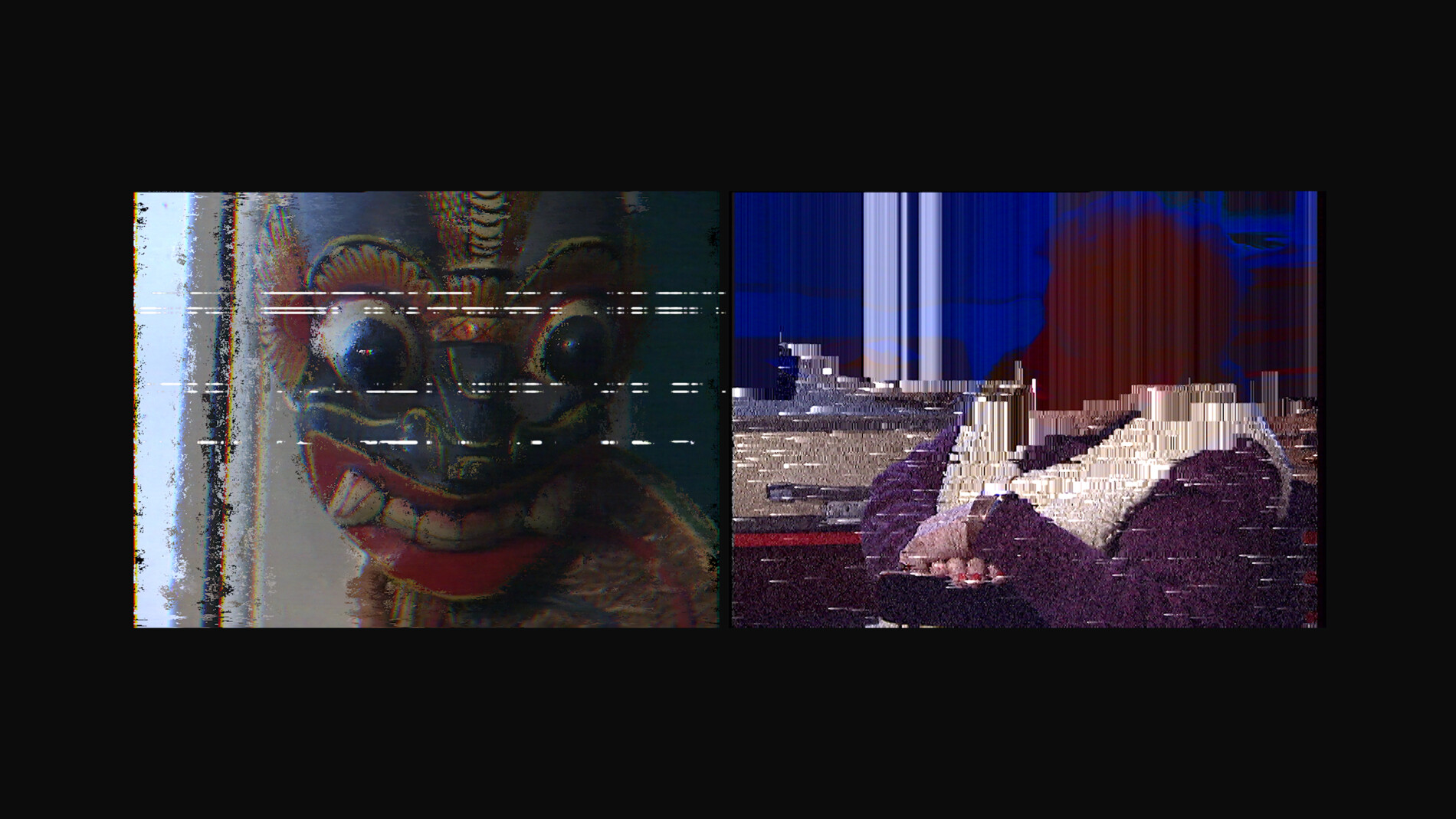
At times the narrative, sustained by black-and-white archive footage, sends us back to 1920s Vienna and gives us glimpses of Holger’s Mechanical Ballet, a dance from 1926 that echoes an earlier version from the Bauhaus (1923) as well as Fernand Léger’s film Ballet Mécanique (1924). We also see the sketch of the original costume and mask designed by Arthur Berger for Holgerand, finally, rummaging in her archive, Holger’s daughter pulls a box from which emerges the original mask, that auratic object.
At times the image documents, at times it dances, at times… it fails: visible and audible interference appears on the surface of the screen, in the form of dissolving pixels and fragmented sounds. Assorted noises interrupt the flow of perception. We might ask ourselves whether this is a superimposition of technological errors as a trace upon history, or a blocking of materiality as a metaphor for a history built on discontinuities. Might we?
Let us pause to look a little longer inside this cardboard box and, in particular, explore the event it invites us to. The story of the dancer-teacher unfolds before our eyes, inviting us down into the basements in which she taught. We immerse ourselves in them, we dance in her classes (even those organised in the underground Vienna of 1938), we discover treasures in her travelling trunks and we experience, with a heavy heart, the feeling of uprootedness as we listen to first-person accounts; yet, in those hidden rooms, we also free ourselves through movement that flows beyond any preestablished rule.
Yes, all of this happens while we contemplate the inside of that box, but always only at moments, because every so often something interrupts this immersion, so rich in affect, and expels us back to the surface of the screen. A counter force places us before the technological failure, harshly reminding us that we do not inhabit those basements of creation, that they are only vestiges of a past time.
On the surface of things, the passage of time takes on a spatial form, and we can picture it as layered with strata and sediments. And if the very movement of an emotion can be sketched on the surface, if affective impression is able to show itself in residual traces and textures, then Hilde’s projected memories manage to organise themselves as weave, as patina and even as stain.
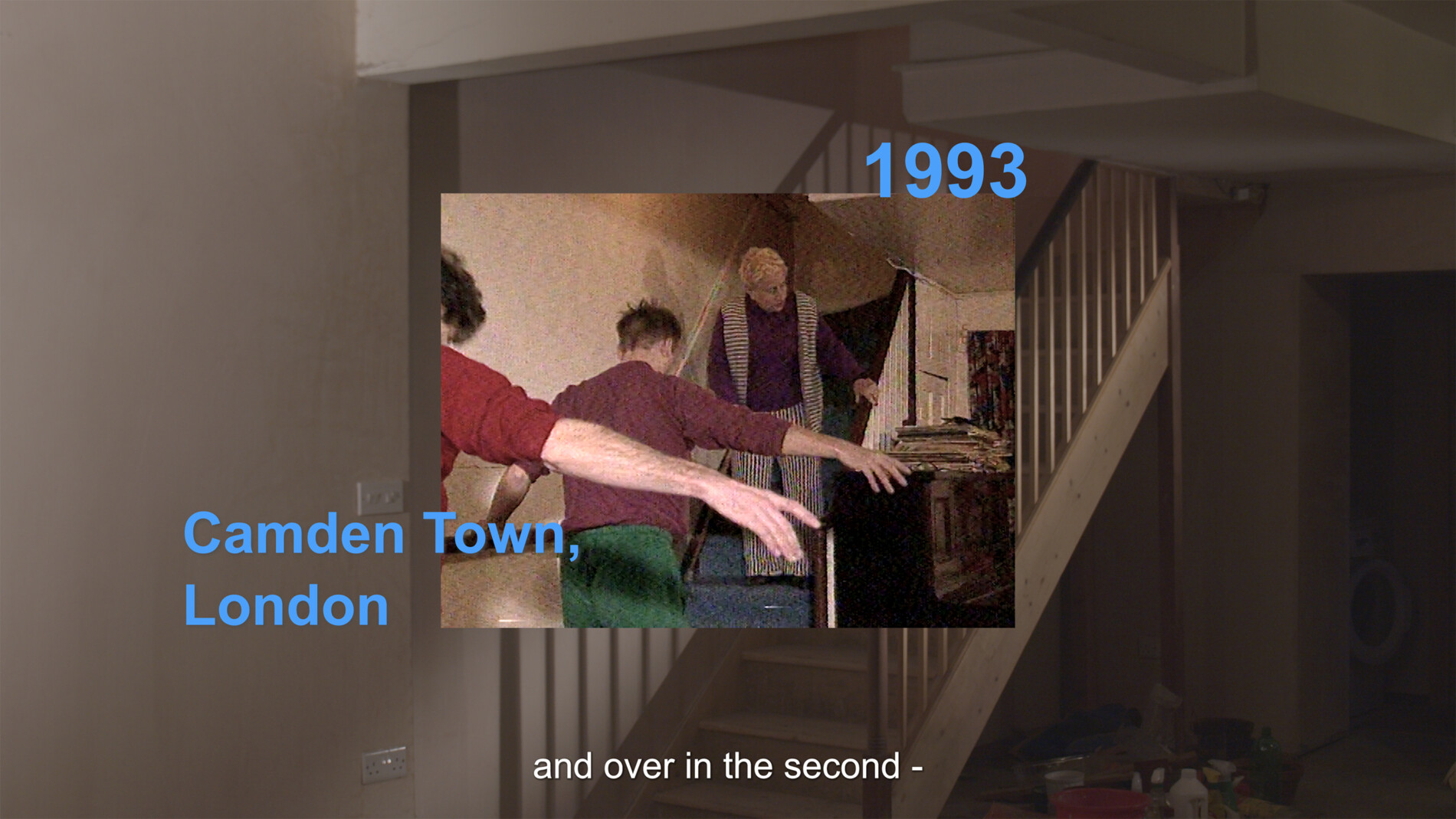
And so, in a back-and-forth that alternates rhythms and interruptions, whoever stops to observe 1905-2001 Vienna – Bombay – London in that far corner of the gallery receives not one but two stories: the story of the life, art and struggle of the great Hilde Holger, and that of electronic mediaart and its capacity to preserve memory. And all of this takes place in the ambivalence of a device that is at times a basement, at times a screen and at times only a cardboard box, placed somewhat awkwardly in the darkness of a space.
*Text inspired by Superfici. A proposito di estetica, materialità e media (2016), by Giuliana Bruno (Johan&Levi Eds.)
de Claudia Kappenberg (Fundación Cazadores, 2026)
(Abriendo los paréntesis) de la memoria / [Opening the Brackets] of Memory consistió en una exposición, presentada por el Memory and Arts Working Group a finales del julio en Buenos Aires, que reunió obras de catorce artistas de diferentes partes del globo alrededor de la temática “memoria y democracia”. La instalación “1905-2001 Vienna – Bombay- Londres” de Claudia Kappenberg, formó parte de este evento.
***
Sin un camino trazado de antemano, la propuesta general consistía en avanzar entre una diversidad de volúmenes, texturas y luminosidades. Este recorrido polisensorial, si bien no presentaba incomodidades físicas, sí podía generar algún tipo de malestar en el plano anímico del/la visitante dado que los paneles y artefactos expuestos en la sala principal de Fundación Cazadores describían, argumentaban e incomodaban entre el recuerdo y la denuncia.
En un ángulo apartado y oscuro hay una caja de cartón abierta de donde emergen haces de luz y sonidos, en un principio, enigmáticos. Hay que arrimarse y mirar de cerca.
En el interior de la caja encontramos una pantalla sobre la que se proyecta una sucesión de recuerdos de la coreógrafa austro-húngara Hilde Holger. Los fragmentos filmados discurren entre tres ciudades: Viena, Bombay y Londres. Diferentes calidades de imagen, coloración y cuerpos en escena describen momentos artísticos y pedagógicos de esta figura de la danza moderna y muestran esos lugares que han sido su hogar y en los que ha podido -no sin grandes dificultades – construir un legado.
Por momentos, la narrativa sostenida en imágenes de archivo en blanco y negro nos reenvía a los años 20 en Viena, y nos da pantallazos del Mechanical Ballet de Holger[1]. Vemos también el boceto del vestuario y de la máscara realizados por Arthur Berger para esa obra y, finalmente, un cúmulo de cajas desde el que la hija de la bailarina extrae diferentes elementos y, entre ellos, vemos surgir aquel objeto aurático.
Por momentos, la imagen documenta, por momentos, baila, por momentos…falla: sobre la superficie de la pantalla aparecen interferencias visibles y audibles en forma de disolución de píxeles y de fragmentación de sonidos. Ruidos diversos que obturan el flujo perceptivo. Podríamos preguntarnos si se trata de una superposición de errores tecnológicos como una traza sobre la historia o de la obturación de la materialidad como metáfora de una historia construida sobre discontinuidades. ¿Podríamos?
Detengámonos a mirar un poco más el interior de esta caja y, en particular, indaguemos en el acontecimiento al que nos invita. La historia de la bailarina-maestra transcurre ante nuestros ojos, nos invita a esos sótanos. Nos sumergirnos en ellos, danzamos en sus clases -incluso en aquellas que se organizan en la Viena subterránea de 1938-, descubrimos tesoros en sus baúles y experimentamos con pesadumbre la sensación de desarraigo escuchando relatos en primera persona, pero, también, en esas habitaciones ocultas, nos liberamos a través del movimiento que fluye por fuera de cualquier regla preestablecida.
Sí, todo esto transcurre mientras contemplamos el interior de esa caja, pero siempre por momentos porque, cada tanto, algo interrumpe esa inmersión abundante en afectos y nos expulsa hacia la superficie de la pantalla. Una fuerza contraria nos sitúa ante la falla tecnológica recordándonos con dureza que no habitamos esos sótanos de creación, que ellos son solo vestigios de un tiempo pasado.
En la superficie de las cosas el devenir adquiere dimensiones espaciales, y así podemos visualizarlo como dotado de estratificaciones y sedimentos. Y si el movimiento mismo de una emoción puede ser esbozado en la superficie, si la impresión afectiva es capaz de manifestarse en rastros y texturas residuales, los recuerdos proyectados de Hilde consiguen organizarse como trama, como pátina e incluso como mancha.
Y así, en un vaivén que alterna ritmos e interrupciones, quien se detiene a observar 1905-2001 Vienna – Bombay- Londres en esa esquina apartada de la sala recibe no una sino dos historias. El relato de vida, arte y lucha de la gran Hilde Holger y el del arte tecnológico y su capacidad de preservación de la memoria. Y todo esto sucede en la ambivalencia de un dispositivo que es por momentos, un sótano, por momentos, una pantalla y por momentos, solo una caja de cartón dispuesta de manera algo incómoda en la oscuridad de una sala.
*Texto inspirado en Superfici. A proposito di estetica, materialità e media (2016) Autora: Giuliana Bruno (Johan&Levi Eds.)
[1] El Ballet Mecánico de Holger (1926) evoca al Ballet Mecánico de la Bauhaus (1923) así como al film Ballet Mécanique (1924) de Fernand Léger.